
Railway pit vs lifting jacks: Which is best for your depot?
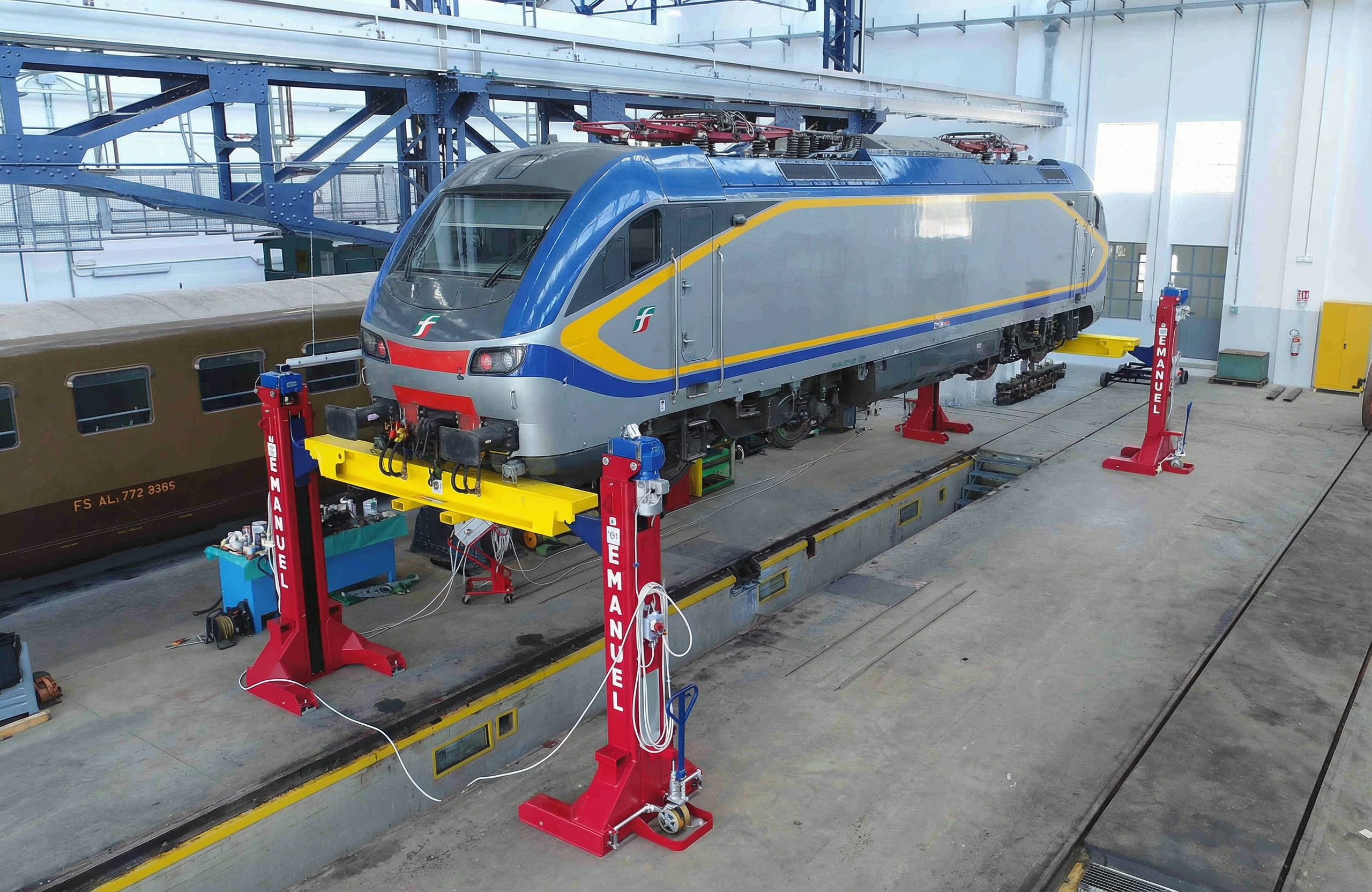
There’s a long-running debate in the automotive industry. And it’s no different in rail workshops:
Which is better — railway pits vs lifting jacks?
There’s no simple answer that applies to every depot. But by understanding the strengths and weaknesses of both, you can find the right fit for your railway workshop.
Here’s what you need to know before you decide:
Railway pit vs lifting jacks:
| Rail pit | Rail lifting jack | |
| Cost | Higher upfront cost Lower maintenance costs |
Lower upfront cost
Higher maintenance costs |
| Installation | Requires groundworks
Some disruption |
No structural changes
No disruption |
| Maintenance | Maintenance and repairs are rare | Need regular servicing |
| Throughput | Service top and bottom together
Only one fixed length at a time |
Can only service undercarriage Can lift entire train at once |
| Space | Always using space Ideal for low ceilings |
Can be stored to create space Not suitable for low ceilings |
| Railway inspection pit | Railway lifting jacks |
1. Cost
Because of the installation and groundworks, a rail inspection pit can often come with a higher upfront cost when compared to a lifting jack.
(It’s not an easy comparison to make, because our lifting jacks can come in sets of up to 128 columns — so a larger set of jacks could potentially cost more than a rail pit.)
But as well as the upfront cost, you need to think about the long-term costs:
Once your railway pit is installed, it can virtually last forever. You won’t need multiple maintenance visits each year, and the ongoing costs of repairs and spare parts is minimal.
So if you’re thinking in the long term — with a premises and layout that you don’t plan to change — a rail pit can end up being more cost-effective over time.
Rail pits vs lifting jacks:
Example costs
| Rail inspection pit (standard installation) |
Railway lifting jacks (set of 8) |
|
| Upfront cost | £70k – £100k | £30k – £40k |
| Annual cost | £3k | £10k |
2. Installation
A rail pit comes with a serious installation. You’ll need a site survey and groundworks, and there’s always going to be some disruption to your schedule while it’s being installed.
But the disruption might not be as much as you think:
Our Totalkare Railway Inspection Pits are prefabricated off-site before they’re delivered and installed in your depot. That means the bulk of the construction happens on our time, not yours — helping to minimise any disruption and keep your workshop up and running for as long as possible.
With a railway lifting jack, there’s essentially no installation to worry about. Your rail jacks are delivered ready to go, and after some setup and training, you can put them to work.
Typical installation times
| Rail inspection pit (standard installation) |
Railway lifting jacks | |
| Off-site construction | 21 days | 0 |
| On-site installation | 7 days | 0 |
3. Maintenance
Once a rail pit is installed, it can virtually last forever, with minimal ongoing maintenance costs or repairs to worry about.
With a railway lifting jack, you’ll need regular service visits (usually every 6 months). And with a more complex lifting mechanism, you’ll eventually need repairs and spare parts.
So while a rail pit can often cost more upfront, a set of lifting jacks can add ongoing costs in the years ahead.
4. Throughput
For a busy rail depot — one where stock is rolling through from open to close — a rail inspection pit can give you the highest throughput. There’s no setup time, and no lifting time. Your trains can move in and over a pit that’s always ready to go, helping you keep your output high and your downtime low.
With a set of railway jacks, there’s always going to be some time lost to setup. You need to position the columns, conduct safety checks, and wait while the carriage is raised and then lowered.
And as a bonus:
With a rail pit, you can service both the underside and the top of your trains at the same time. That potentially means completing services twice as fast — and processing twice as many trains in a day.
5. Space
A railway pit is a fixed installation. When it’s not in use, it’s still taking up floor space that can’t be recovered.
For workshops with limited space, that can make lifting jacks a more attractive option. With their mobile design and slim frame, you can remove a set of jacks and store them when they’re not in use — giving you more floor space and traffic routes for your teams to work in.
But there’s one area where a rail pit still has the edge: if you’re limited in vertical space.
A set of lifting jacks require ceilings at a certain height. You need enough vertical space for both the height of the train, and the height of the lifting operation. For premises with low ceilings (or obstructions above the train), this can make it impossible to use a set of jacks.
With a railway inspection pit, you don’t have that problem. You can service trains in any area, regardless of your ceiling height — which for some premises, could be enough to make a rail pit the right choice.
Need help deciding?
As well as supplying a full range of railway lifting jacks, we’re also experienced installers of prefabricated rail inspection pits.
Our expert installation teams can help you with:
- Site surveys and planning
- Custom designs tailored to your depot
- Options for tunnels, recesses, and underground workshops.
So if you’re looking for an upgrade but you need an expert opinion, start a chat with one of our workshop specialists — and we’ll talk you through your options to help you find the right fit.